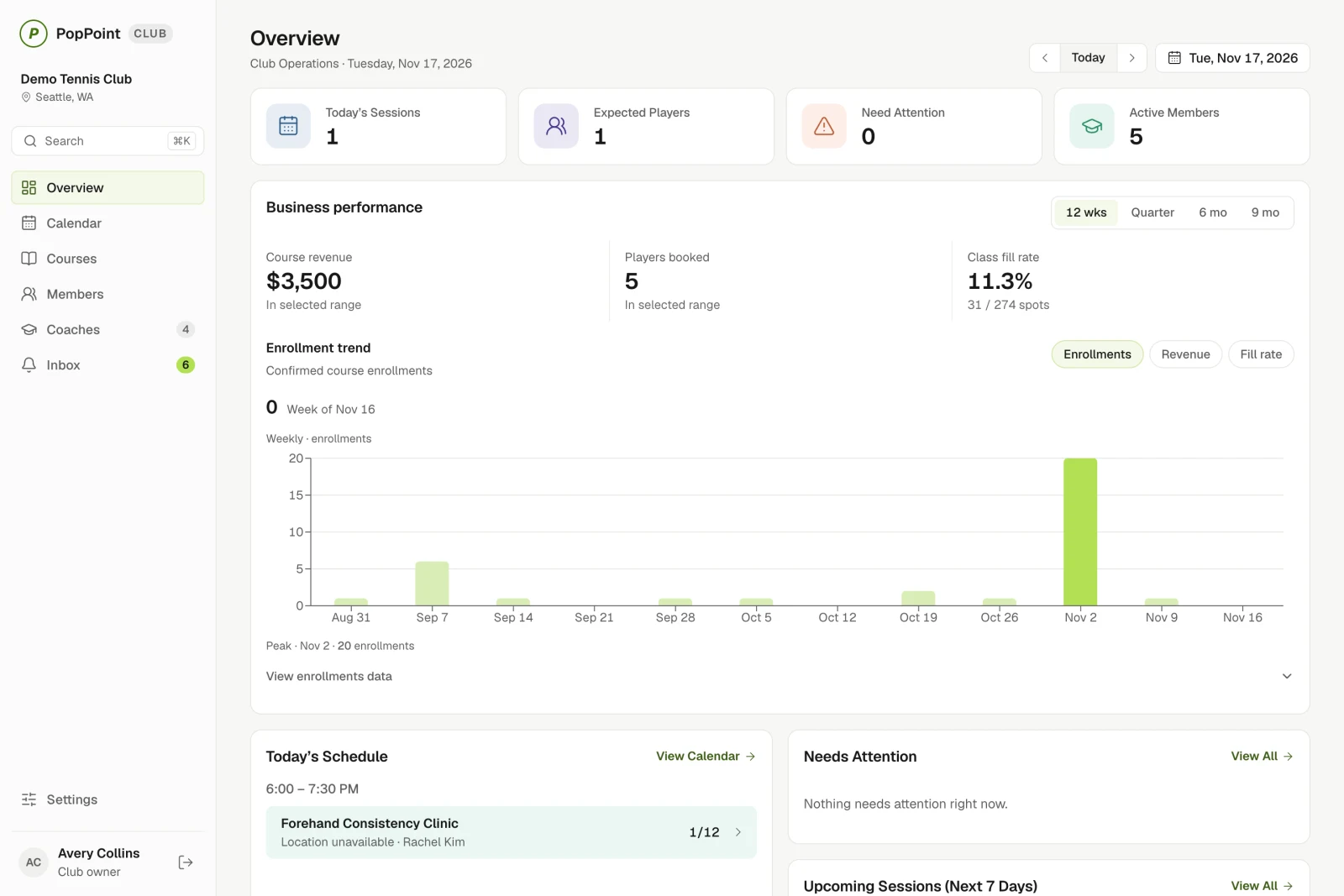
My work covers the backend, web apps, iOS and the WeChat mini program. The clients share player development records containing video assessments, lesson feedback and training recommendations, linked to courses and bookings.
The team shipped the first release in 6 weeks, covering course management, bookings, development records and the coach workspace. The pilot began at 13 clubs in November 2026.
Shared business rules and permissions
The Platform API handles shared business rules and permissions. Clients organize their pages around players, coaches, clubs and operations. Separate background services process video analysis and message delivery, with longer work passed through events.
- ClientsThree web apps for clubs, coaches and operations, plus SwiftUI iOS and WeChat. They share an HTTP contract, with TypeScript types and OpenAPI derived from the same Zod schemas.
- Platform APINode.js, TypeScript and PostgreSQL handle accounts, courses, enrollment, payments, assessments and development records. Staff roles, coaching relationships and sharing consent are checked on the server.
- Platform WorkerConsumes a transactional outbox for notifications, scheduled work and analysis requests. SQS carries video analysis requests to the AI Backend.
- AI BackendPython services separate video ingest, analysis and review. They persist job state and assessment artifacts, then return results to Platform through internal APIs.
Sending submitted videos for analysis
Confirming a video submission saves its state and analysis event in one database transaction. Before sending the request, the Worker rechecks the submission version and media source so replaced or deleted videos do not restart analysis.
The outbox stores pending events. Workers claim them under leases and retry failures with backoff. Recipients use idempotency keys and version checks to handle repeated requests, allowing recovery if a process stops after committing to the database but before sending the request. Booking messages, assessment notifications and account media cleanup use the same mechanism.
From video assessment to the next lesson
Analysis results retain media provenance and scoring versions before publication to the player’s development record. Reviewers can inspect clips, edit reports and choose recommended courses. Publication rechecks clip and course state, releases only approved video, and saves the assessment revision and operation receipt.
Coaches access development records within valid coaching relationships and sharing consent. Recommendations link an assessment to a course and session, tracking views, booking clicks and enrollment so training advice has a concrete next step.
Video Agent Harness (demo)
A separate tool-driven agent demo supports video review. It first indexes shot events, motion metrics and clips. The model queries that evidence, compares strokes and selects clips. Code checks sources and metrics, while constrained templates produce values and factual text.
Execution limits tool calls, time and tokens, and distinguishes model output from template fallback. This capability is still being evaluated in a separate demo and has not shipped as a platform feature.
Delivery and operating records
Blue-green deployment on AWS supports candidate verification, traffic switching and rollback. The first two pilot weeks recorded no service outages.
A historical measurement on November 12, 2026 covered 300 successful /v1/ business requests over the preceding 24 hours. Application P95 was 309.2 ms, approximately 310 ms, including authentication and business processing but excluding client network time.